


Types of energy resources as Renewable and Non-renewable energy
Energy resources can be broadly categorized into two main types: Renewable and Non-renewable energy resources. These categories are based on the availability and the rate at which the resources can be replenished.
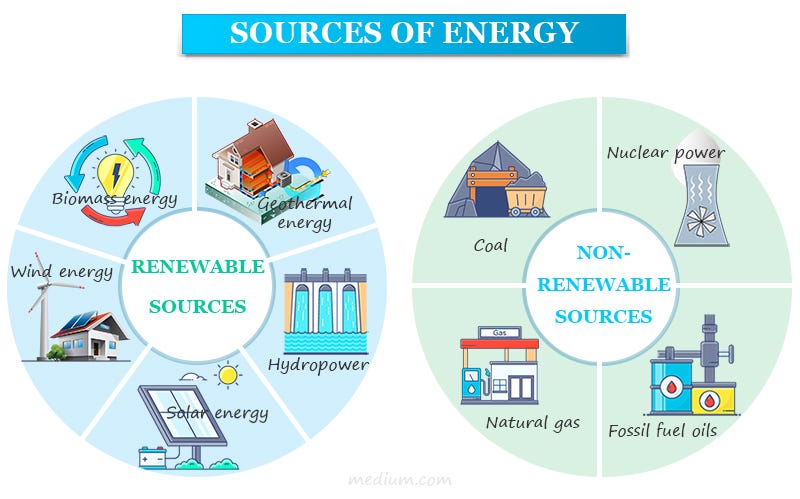
1. Renewable Energy Resources
Renewable energy resources are those that can be replenished naturally over a short period of time. They are considered sustainable because they are either abundant or can be replenished naturally at a rate that meets or exceeds their consumption.
Types of Renewable Energy Resources:
Solar Energy:
- Source: The Sun.
- Description: Solar energy is harnessed using solar panels (photovoltaic cells) that convert sunlight directly into electricity or through solar thermal systems that use the sun’s heat.
- Advantages: Abundant, clean, and inexhaustible.
- Examples: Solar panels on rooftops, solar farms, and solar water heaters.
Wind Energy:
- Source: Wind.
- Description: Wind energy is generated using wind turbines that convert the kinetic energy of wind into mechanical power, which is then converted into electricity.
- Advantages: Clean, renewable, and increasingly cost-effective.
- Examples: Onshore and offshore wind farms.
Hydropower:
- Source: Flowing water.
- Description: Hydropower plants generate electricity by using the energy of flowing or falling water to spin turbines connected to generators.
- Advantages: Reliable, efficient, and capable of providing large-scale electricity.
- Examples: Dams, run-of-river systems, and pumped-storage hydropower.
Biomass Energy:
- Source: Organic materials (wood, agricultural residues, waste).
- Description: Biomass energy is produced by burning organic materials to generate heat and electricity or by converting them into biofuels.
- Advantages: Can reduce waste and is considered carbon-neutral if sourced sustainably.
- Examples: Wood pellets, biogas from landfills, and bioethanol from crops.
Geothermal Energy:
- Source: Heat from the Earth’s interior.
- Description: Geothermal energy is obtained by tapping into the Earth’s internal heat to generate electricity or provide direct heating.
- Advantages: Consistent, low emissions, and highly efficient in suitable locations.
- Examples: Geothermal power plants, geothermal heat pumps.
Tidal and Wave Energy:
- Source: Ocean tides and waves.
- Description: Tidal and wave energy harness the movement of seawater to generate electricity.
- Advantages: Predictable and can produce a significant amount of energy.
- Examples: Tidal barrages, tidal stream generators, and wave energy converters.
2. Non-Renewable Energy Resources
Non-renewable energy resources are those that exist in finite quantities or are replenished at a rate much slower than the rate at which they are consumed. Once depleted, they cannot be replaced within a human timescale.
Types of Non-Renewable Energy Resources:
Fossil Fuels (Coal, Oil, Natural Gas):
- Source: Ancient organic matter buried and transformed over millions of years.
- Description: Fossil fuels are burned to release energy, typically in the form of heat, which is then used to generate electricity, power vehicles, and heat buildings.
- Advantages: High energy density and well-established infrastructure.
- Disadvantages: Significant greenhouse gas emissions, air pollution, and finite reserves.
- Examples: Coal-fired power plants, oil refineries, and natural gas plants.
Nuclear Energy:
- Source: Uranium, plutonium, and other radioactive materials.
- Description: Nuclear energy is produced through nuclear fission, where atomic nuclei are split to release a large amount of energy, which is used to generate electricity.
- Advantages: Low direct greenhouse gas emissions and high energy output.
- Disadvantages: Radioactive waste, risk of nuclear accidents, and finite uranium resources.
- Examples: Nuclear reactors in power plants.