


Solubilisation of phosphates
Phosphate solubilization is the process by which insoluble forms of phosphate are converted into soluble forms that can be readily absorbed by plants and microorganisms. This process is crucial for plant nutrition and soil fertility, as phosphorus is a key nutrient that often limits plant growth. In microbiology, certain microorganisms, known as phosphate-solubilizing microorganisms (PSMs), play a vital role in this process.

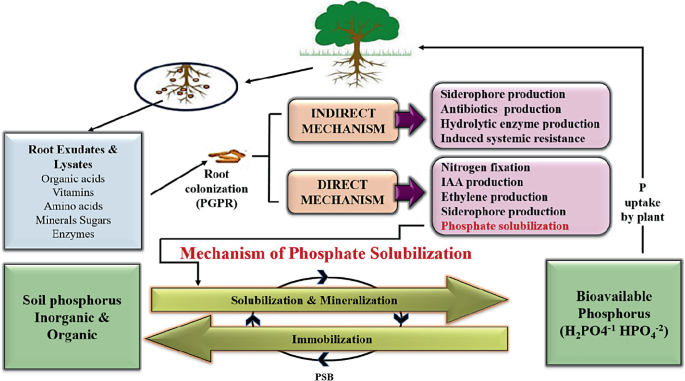
Importance of Phosphate Solubilization
Phosphorus is a major essential nutrient for plants, involved in various physiological processes including energy transfer, photosynthesis, and nutrient movement within the plant. Despite its abundance in the soil, much of it is in insoluble forms that plants cannot uptake. Phosphate solubilization by microorganisms helps in converting these insoluble forms into bioavailable forms, enhancing plant growth and agricultural productivity.
Mechanisms of Phosphate Solubilization
Phosphate solubilizing microorganisms employ various mechanisms to solubilize phosphates:
Production of Organic Acids:
- Microorganisms produce organic acids such as citric acid, oxalic acid, lactic acid, acetic acid, gluconic acid, and malic acid.
- These acids lower the pH of the surrounding environment, which leads to the dissolution of insoluble phosphate compounds, releasing phosphate ions into the soil solution.
Enzymatic Activity:
- Enzymes such as phosphatases, phytases, and C-P lyases are produced by microorganisms.
- These enzymes hydrolyze organic phosphorus compounds into inorganic phosphate, making it available for plant uptake.
Chelation:
- Microorganisms produce chelating agents (siderophores) that bind to metal ions such as calcium, iron, and aluminum, which are often associated with phosphate, forming soluble complexes and releasing phosphate ions.
Ion Exchange:
- Certain microbial metabolites can exchange ions with insoluble phosphate compounds, leading to the release of phosphate ions.
Redox Reactions:
- Some microorganisms can alter the oxidation state of phosphorus, facilitating its solubilization.
Types of Phosphate-Solubilizing Microorganisms
Bacteria:
- Pseudomonas spp., Bacillus spp., Rhizobium spp., Enterobacter spp., and Azospirillum spp. are well-known phosphate-solubilizing bacteria.
- These bacteria are often found in the rhizosphere, the soil region near plant roots, where they interact with plant roots and enhance phosphorus availability.
Fungi:
- Aspergillus spp., Penicillium spp., and Trichoderma spp. are notable phosphate-solubilizing fungi.
- Fungi can solubilize phosphate more effectively than bacteria due to their extensive hyphal networks, which can explore a larger soil volume.
Actinomycetes:
- Certain actinomycetes like Streptomyces spp. also possess phosphate-solubilizing capabilities.
Applications of Phosphate-Solubilizing Microorganisms
Agriculture:
- PSMs are used as biofertilizers to enhance phosphorus availability in the soil, promoting plant growth and increasing crop yields.
- They can be applied to seeds, soil, or as part of composts and manures.
Sustainable Farming:
- Use of PSMs reduces the dependency on chemical phosphate fertilizers, leading to sustainable and eco-friendly farming practices.
- They help in maintaining soil health and fertility over the long term.
Rehabilitation of Degraded Lands:
- PSMs can be used in the rehabilitation of degraded and phosphorus-deficient soils, improving soil structure and fertility.
Challenges and Future Prospects
Variability in Field Conditions:
- The effectiveness of PSMs can vary widely depending on soil type, pH, temperature, moisture, and the presence of other microorganisms.
- Understanding the interactions between PSMs and the soil environment is crucial for optimizing their application.
Strain Selection and Genetic Improvement:
- Selecting efficient strains and genetically enhancing PSMs for higher phosphate solubilization potential is an ongoing area of research.
- Genetic engineering and synthetic biology approaches are being explored to develop more effective PSM strains.
Formulation and Delivery:
- Developing stable and effective formulations for the delivery of PSMs to the field is a significant challenge.
- Research is focused on improving the shelf life, viability, and efficacy of PSM formulations.