


Microbes in decomposition, mineralisation and recycling process
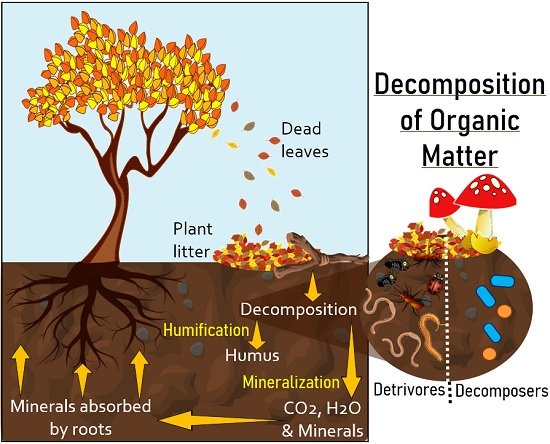 Microorganisms play a crucial role in the decomposition of organic matter, mineralization of nutrients, and the recycling of elements within ecosystems. Their activities ensure the continuous availability of essential nutrients for plant and animal life and help maintain ecosystem stability.
Decomposition
Decomposition is the process by which organic substances are broken down into simpler organic or inorganic matter. It is a key step in the recycling of nutrients in ecosystems.
Key Microorganisms Involved in Decomposition
Bacteria:
- Bacteria are primary decomposers of dead plant and animal tissues.
- They secrete extracellular enzymes that break down complex organic compounds such as cellulose, hemicellulose, proteins, and lipids into simpler compounds.
- Examples include Bacillus, Pseudomonas, and Streptomyces species.
Fungi:
- Fungi are efficient decomposers, particularly of complex plant materials like lignin and cellulose.
- Saprophytic fungi, such as Aspergillus, Penicillium, and Trichoderma, play a significant role in decomposing organic matter in soil and leaf litter.
- White-rot fungi and brown-rot fungi are specialized in breaking down lignin and cellulose, respectively.
Actinomycetes:
- Actinomycetes, such as Streptomyces species, decompose complex organic compounds, producing a characteristic earthy smell in soil.
- They are particularly important in degrading tough organic materials like chitin and lignocellulose.
Protozoa and Nematodes:
- These microorganisms consume bacteria and fungi, regulating microbial populations and recycling nutrients back into the soil.
Process of Decomposition
Leaching:
- Water-soluble substances are leached out from decomposing organic matter, making them available for microbial uptake.
Fragmentation:
- Soil fauna such as earthworms, insects, and other detritivores break down organic matter into smaller pieces, increasing the surface area for microbial action.
Catabolism:
- Microorganisms secrete enzymes to break down complex organic compounds into simpler molecules.
- This involves both aerobic and anaerobic metabolic pathways, depending on the availability of oxygen.
Humification:
- The formation of humus, a stable organic matter, results from the microbial and chemical transformation of organic residues.
- Humus enhances soil structure, water retention, and nutrient-holding capacity.
Mineralization
Mineralization is the conversion of organic compounds into inorganic forms, making nutrients available for plant uptake.
Key Processes in Mineralization
Nitrogen Mineralization:
- Proteins and nucleic acids in organic matter are broken down by bacteria and fungi into ammonium (NH4+).
- Ammonium can be further oxidized by nitrifying bacteria into nitrate (NO3-), a process known as nitrification.
- Examples of microorganisms involved include Nitrosomonas and Nitrobacter species.
Phosphorus Mineralization:
- Organic phosphorus compounds are decomposed by phosphate-solubilizing bacteria and fungi into inorganic phosphate.
- Enzymes such as phosphatases play a crucial role in this process.
- Examples include Pseudomonas, Bacillus, and Aspergillus species.
Sulfur Mineralization:
- Organic sulfur compounds are converted into sulfate (SO4^2-) by sulfur-oxidizing bacteria.
- Examples include Thiobacillus and Desulfovibrio species.
Recycling
Recycling involves the return of nutrients to the ecosystem, ensuring their continuous availability.
Key Microbial Processes in Recycling
Carbon Cycle:
- Decomposers break down dead organic matter, releasing carbon dioxide (CO2) through respiration.
- Some carbon is incorporated into microbial biomass and soil organic matter, contributing to soil carbon storage.
Nitrogen Cycle:
- Nitrogen-fixing bacteria (e.g., Rhizobium, Azotobacter) convert atmospheric nitrogen (N2) into ammonia (NH3), making it available to plants.
- Decomposers mineralize organic nitrogen, while nitrifying bacteria convert ammonia to nitrate.
- Denitrifying bacteria (e.g., Pseudomonas, Clostridium) convert nitrate back to N2, completing the nitrogen cycle.
Phosphorus Cycle:
- Phosphate-solubilizing microorganisms release inorganic phosphate from organic compounds.
- Mycorrhizal fungi enhance phosphate uptake by plant roots, forming symbiotic associations.
Sulfur Cycle:
- Sulfur-oxidizing bacteria convert hydrogen sulfide (H2S) into sulfate, which can be assimilated by plants.
- Sulfate-reducing bacteria convert sulfate back to sulfide in anaerobic conditions.